Milk thistle: the liver research and safety
Milk thistle is a daisy-family plant whose seed extract, silymarin, is sold in the UK as tablets, capsules and tea, mostly for the liver. It has no authorised health claim, the most rigorous liver trials found no clear benefit, and anyone with a liver condition or abnormal liver tests should see a GP rather than treat themselves.
By The Natura team8 min read
What is milk thistle for?
Most people take milk thistle hoping it will help their liver. No product in Great Britain is allowed to say it does, because the plant has no authorised health claim. Some UK milk thistle tablets are licensed as traditional herbal medicines for indigestion after occasional overindulgence; the rest are food supplements with no approved use.
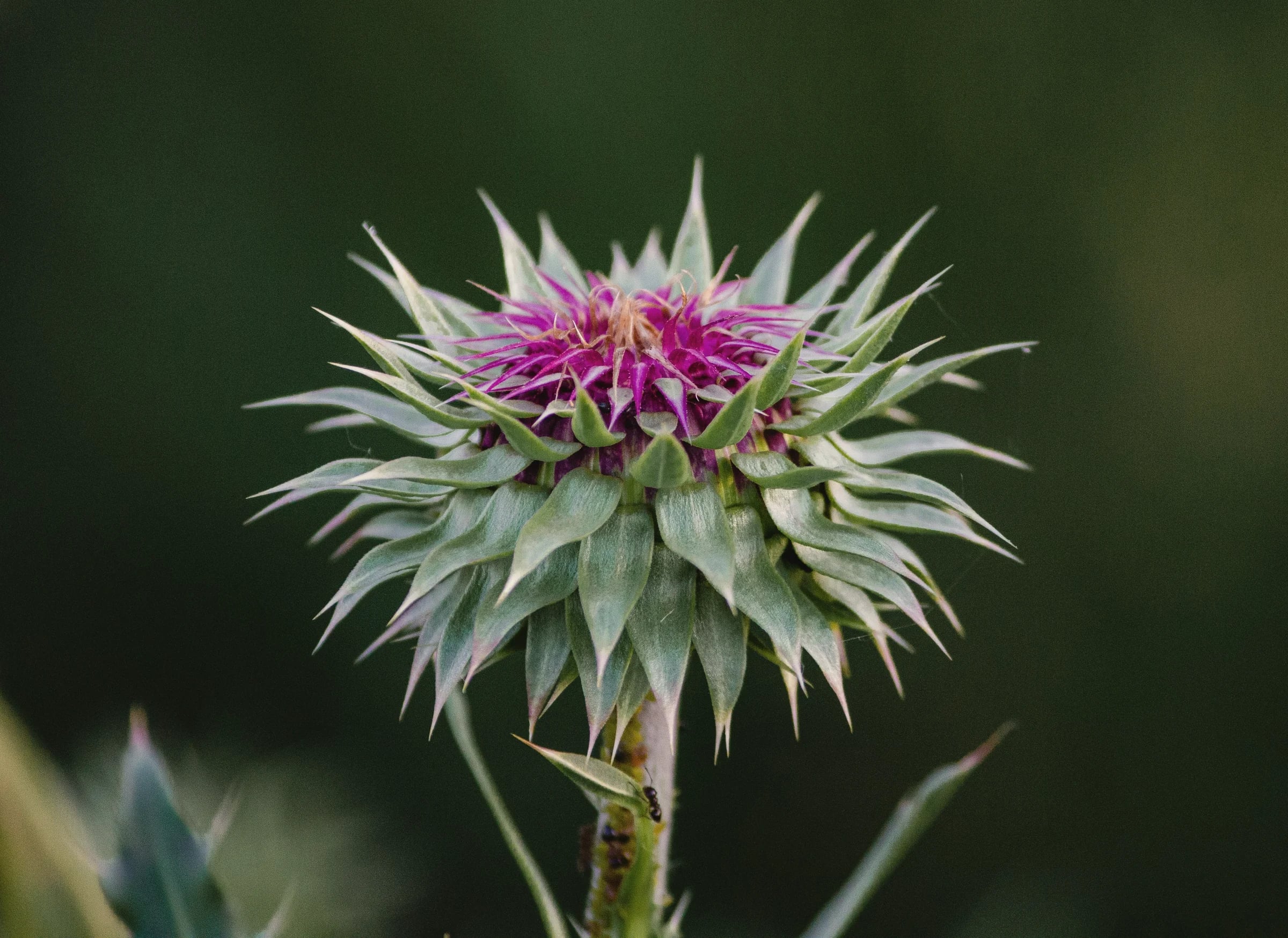
Milk thistle (Silybum marianum) is a tall, purple-flowered plant native to Europe. Supplements use its fruit, usually called the seed, which contains silymarin: a mixture of compounds whose best-known member is silibinin (also spelled silybin). According to the US National Center for Complementary and Integrative Health (NCCIH), it was historically used for liver disorders and to increase breast milk. Great Britain's register of nutrition and health claims holds no authorised claim for it, and a claim that a milk thistle extract improves breast milk production is listed there as not authorised.
The plant belongs to the daisy family (Asteraceae), alongside ragweed, chrysanthemums, marigolds, daisies and artichokes. NCCIH says people allergic to those plants are the most likely to react to it.
Is milk thistle good for your liver?
It hasn't been shown to be. Most trials have been in people with liver disease, and the better designed the trial, the weaker the result.
- A 2007 Cochrane review pooled 18 randomised trials in 1,088 people with alcohol-related liver disease or hepatitis B or C. Milk thistle made no significant difference to deaths, complications of liver disease or liver biopsy findings. Liver-related deaths were lower when all the trials were pooled, but not in the high-quality ones, and only 28.6% of the trials reported high-quality methods. The reviewers concluded that their results questioned any benefit.
- In a US trial funded by the National Institutes of Health, 154 people with hepatitis C took silymarin at higher than usual doses (420 mg or 700 mg three times a day) or a placebo for 24 weeks. Their liver enzyme (ALT) levels fell no more than with placebo.
- A companion trial in 78 people with non-alcoholic steatohepatitis, a more serious form of fatty liver disease, found no benefit after 48 weeks. The authors called the result inconclusive, partly because many participants turned out not to meet the entry criteria.
- In 2018 the European Medicines Agency's herbal committee said liver studies had hinted at effects, but poor design, small numbers and varying doses ruled out firm conclusions.
NCCIH sums it up this way: trials in alcohol-related liver disease, hepatitis B and C, fatty liver disease and liver damage from chemotherapy or toxins have been conflicting or too limited to allow conclusions.
If you're worried about your liver
The NHS says most types of liver disease cause no symptoms in the early stages, and fatty liver disease is usually found by tests done for something else. If a blood test has shown abnormal liver results, or you've been diagnosed with a liver condition, talk to your GP before taking milk thistle or any other herbal product. For fatty liver disease the NHS recommends lifestyle changes, with specialist treatment if the liver is damaged.
Is milk thistle good for you?
Most adults seem to tolerate it, but there's no established benefit to weigh against the risks. In the Cochrane review, side effects were no more common with milk thistle than with placebo, and the two US trials found the same at high doses. NCCIH lists bloating, nausea and wind as the commonest side effects; the EU monograph adds upset stomach, diarrhoea, headache and allergic skin reactions.
NCCIH also reports that a small number of studies, mostly from Middle Eastern countries, suggest milk thistle extracts may help control blood sugar in type 2 diabetes, and that it's unclear whether the results would hold elsewhere. If you take diabetes medicines, that's a reason to ask a pharmacist before you start.
Who should not take milk thistle
The UK patient leaflet for a registered milk thistle medicine says not to take it if you:
- are allergic to plants in the daisy family
- are pregnant or breastfeeding (NCCIH says little is known about safety in either)
- are under 18
The EU monograph also advises against it in these groups, and the UK leaflet asks anyone with liver problems to talk to a pharmacist or doctor first.
What medications should not be taken with milk thistle?
No medicine is formally ruled out. The UK leaflet says milk thistle isn't expected to affect other medicines, and the EU monograph lists no reported interactions. A 2021 systematic review of silymarin found that most human studies showed no interactions, and that the effects seen in lab tests usually need concentrations higher than the body reaches after normal doses. A few small studies did find changes, though, so ask a pharmacist if you take any regular medicine.
| Medicine | What we know | Source |
|---|---|---|
| Losartan (for blood pressure) | In 12 healthy men, 140 mg of silymarin three times a day for 14 days slowed the conversion of losartan to its active form, by an amount that depended on their genes | Han et al. 2009 |
| Metronidazole (an antibiotic) | In 12 healthy volunteers, 140 mg of silymarin a day for 9 days made the body clear metronidazole about 30% faster | Rajnarayana et al. 2004 |
| Diabetes medicines | Milk thistle may lower blood sugar in type 2 diabetes | NCCIH |
| Warfarin | Tell your doctor about any herbal remedy before taking it alongside warfarin | NHS |
Our guide to supplements you can take together covers how to check a combination with a pharmacist.
Milk thistle tablets, capsules or tea?
Tablets and capsules give a measured amount of extract. A cup of tea gives an unknown amount.
Licensed tablets and food supplements in the UK
Milk thistle is sold in the UK in two ways. The MHRA's list of registered herbal medicines, updated in October 2025, includes nine registrations for products containing milk thistle, many of them sold under several shop brands. Each is a Traditional Herbal Registration (THR), and the single-herb products are registered "to relieve the symptoms associated with occasional over indulgence of food and drink such as indigestion and upset stomach", based on traditional use only. None is registered for the liver.
A THR is a licence for a herbal medicine. The MHRA grants one only for minor conditions that don't need medical supervision, and the applicant has to show that the herb has been used that way for at least 30 years, along with evidence of its safety and quality. Trials showing the medicine works aren't required: the European Medicines Agency describes traditional use as resting on long-standing use, with too little clinical trial evidence to show effectiveness. A registered product carries a THR number and comes with a patient leaflet. A food supplement has neither, has no approved use, and can't claim a health benefit for milk thistle. Ginkgo and ginseng also have UK registered medicines; our guides to ginkgo biloba and ginseng explain what those are registered for.
What's the best milk thistle supplement in the UK?
No single product suits everyone. These checks help you compare labels:
- If you want a product with an approved use and a leaflet listing who shouldn't take it, look for a THR number on the pack.
- Compare silymarin in milligrams. The registered single-herb products state between 50 mg and about 300 mg of silymarin per tablet or capsule, "calculated as silibinin".
- Read "herb equivalent" figures carefully. A label claiming "10,000 mg equivalent" from a 50:1 extract contains 200 mg of actual extract, and the silymarin percentage tells you how much of that is silymarin.
- Ask how each batch was tested, for example by a third-party laboratory. When Czech researchers analysed 26 milk thistle supplements bought in the US and the Czech Republic, silymarin content varied widely and often didn't match the label, and every product contained mycotoxins (toxins made by moulds) and pesticide residues, with substantial microbial contamination too.
- Take one product at a time. Milk thistle turns up in blends and packs, so check you aren't taking it twice.
Milk thistle tea
The EU monograph for traditional milk thistle medicines includes a tea made from 3 to 5 g of crushed fruit in 100 ml of boiling water, two or three times a day before meals. In a 2003 lab study, water at boiling point pulled some silymarin compounds out of the seed, but even after three and a half hours it recovered only about 30% of the silibinin that a solvent extraction did. We found no trials of milk thistle tea, so there's no way to know how much silymarin a cup contains.
When to take milk thistle, and how
No research compares times of day, so follow the label. The US trials gave silymarin three times a day. The EU monograph lists most milk thistle medicines before meals, while the UK leaflet we read says one capsule once or twice a day, swallowed whole with water, with no set time. Don't take more than the label says. If you're taking it for indigestion, the UK leaflet asks you to see a doctor or pharmacist if symptoms get worse or haven't gone within a week; the EU monograph says two weeks.
Common questions
Does milk thistle detox your liver?
No product can lawfully say so. Milk thistle has no authorised health claim in Great Britain, and trials in people with liver disease, including a Cochrane review of 18 trials and two US trials, found no clear benefit. The NHS says most liver disease causes no symptoms early on, so if you're worried about your liver, ask your GP about a blood test.
What happens if you take milk thistle every day?
In trials, people took silymarin daily for up to 48 weeks, at higher than usual doses, and side effects were no more common than on placebo. The usual complaints are digestive: bloating, nausea, wind or an upset stomach. There's no authorised benefit from daily use, and if you're taking it for indigestion that hasn't settled within one to two weeks, see a doctor or pharmacist.
Is milk thistle the same as silymarin?
Not quite. Milk thistle is the plant, silymarin is the mixture of compounds extracted from its fruit (the seed), and silibinin is the main one. Registered UK products state their silymarin content "calculated as silibinin", which is the most useful number to compare. A label that only gives "herb equivalent" milligrams tells you how much raw fruit went in, not how much silymarin you get.
Can milk thistle increase breast milk?
It was used for that in the past, but NCCIH says it's unclear whether it has any effect, and Great Britain's register of health claims lists a breast milk claim for a milk thistle extract as not authorised. The UK leaflet we read for a registered milk thistle medicine says not to take it while breastfeeding. If you're worried about your milk supply, speak to your midwife, health visitor or GP.
Is milk thistle safe if you have liver disease?
Ask your GP or liver team first. The UK leaflet for a registered milk thistle medicine asks anyone with liver problems to talk to a pharmacist or doctor before taking it. Trials in people with liver disease didn't find more side effects than placebo, but they didn't find a clear benefit either, and a supplement can't replace the monitoring and treatment the NHS provides.
Sources
- NCCIH (US National Institutes of Health): Milk thistle, usefulness and safety
- Rambaldi, Jacobs and Gluud (2007), Cochrane Database of Systematic Reviews: Milk thistle for alcoholic and/or hepatitis B or C virus liver diseases
- Fried et al. (2012), JAMA: silymarin in chronic hepatitis C, randomised controlled trial
- Navarro et al. (2019), PLOS ONE: silymarin in non-alcoholic steatohepatitis, randomised controlled trial
- European Medicines Agency: Milkthistle fruit (Silybi mariani fructus), herbal medicine summary
- European Medicines Agency (2018): European Union herbal monograph on Silybum marianum (L.) Gaertn., fructus
- MHRA (GOV.UK): Herbal medicines granted a traditional herbal registration (list updated October 2025)
- MHRA (GOV.UK): Apply for a traditional herbal registration (THR)
- emc: patient leaflet for a milk thistle traditional herbal medicine (THR 23056/0010)
- GOV.UK: Great Britain nutrition and health claims (NHC) register
- Tvrdý et al. (2021), Medicinal Research Reviews: pharmacokinetics and potential interactions of silymarin, systematic review
- Han et al. (2009), European Journal of Clinical Pharmacology: silymarin and losartan in healthy volunteers
- Rajnarayana et al. (2004), Arzneimittelforschung: silymarin and metronidazole in healthy volunteers
- Fenclova et al. (2019), Scientific Reports: quality of 26 commercial milk thistle supplements
- Barreto et al. (2003), Applied Biochemistry and Biotechnology: hot water extraction of milk thistle
- NHS: Liver disease
- NHS: Non-alcoholic fatty liver disease (NAFLD)
- NHS: Warfarin
This guide is general information, not medical advice. If you have a medical condition, take prescription medicines, or are pregnant or breastfeeding, speak to your GP or pharmacist before starting a supplement.
This product is a food supplement intended for use by adults aged 18 and over. It is not intended to diagnose, treat, cure, or prevent any disease. Consult a qualified healthcare professional before use, particularly if pregnant, breastfeeding, or taking medication. Individual results vary.
Further reading
Vitamins and minerals
Which supplements can you take together?
Most vitamins and minerals, vitamin C and zinc included, can be taken together. Keep iron about 2 hours away from calcium, tea, coffee and antacids, keep mineral supplements away from medicines such as levothyroxine, alendronic acid and some antibiotics, and add up your totals so two products don't take you past NHS limits.
15 min read
Herbs and botanicals
Ginkgo biloba: what the research shows
Ginkgo biloba is a leaf extract from the maidenhair tree, sold in the UK mostly as a food supplement. Despite its reputation, large trials found it didn't prevent dementia, reviews on tinnitus are inconclusive, it has no authorised health claim, and it can add to bleeding risk with some medicines and before surgery.
7 min read
Herbs and botanicals
Ginseng benefits, types and who should avoid it
Ginseng usually means Panax ginseng, an Asian root sold dried (white) or steamed (red), while American ginseng is a close relative and Siberian ginseng is a different plant. Small trials have tested ginseng for tiredness, thinking and more, but it has no authorised health claim in Great Britain, and it can interact with warfarin and diabetes medicines.
6 min read