Omega-3 foods: which have the most?
Oily fish such as mackerel, sardines, kippers, salmon and trout are the richest omega-3 foods, and they give the long-chain fats EPA and DHA. Walnuts, linseed, chia, rapeseed oil and soya give ALA, a plant omega-3 the body turns into EPA and DHA only in small amounts.
By The Natura team6 min read
What foods contain omega-3?
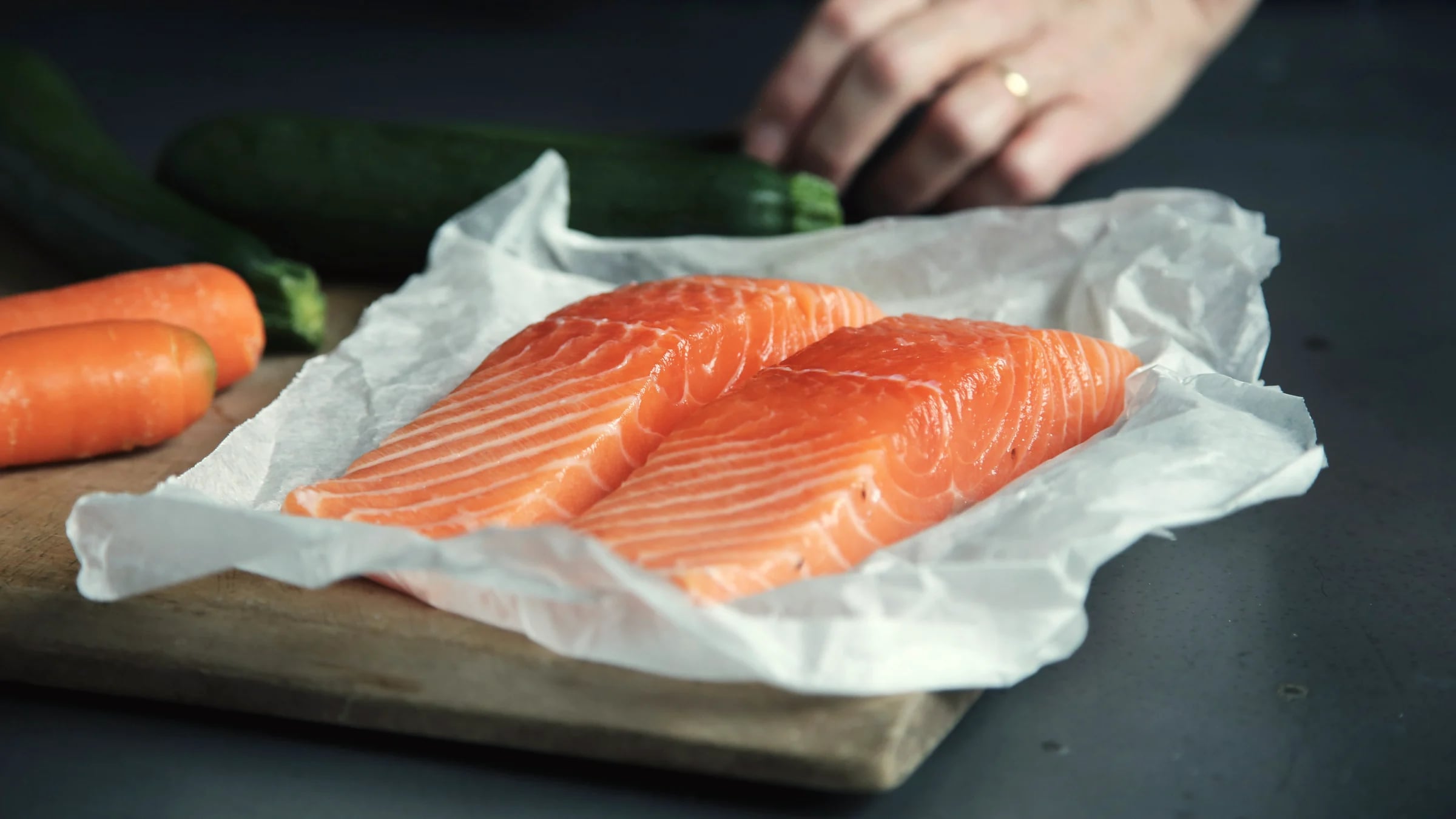
Oily fish contain the most omega-3, followed by some shellfish, then plant foods such as walnuts, linseed, chia seeds, rapeseed oil and soya. Which food you pick matters, because omega-3 fatty acids come in three main types that the body handles differently.
- ALA (alpha-linolenic acid) is the plant omega-3. It's an essential fat, so it has to come from food.
- EPA (eicosapentaenoic acid) and DHA (docosahexaenoic acid) are the long-chain omega-3s. They come mainly from fish and seafood, and the fish get them from micro-algae in the food chain.
Your body can make some EPA and DHA from ALA, but the British Dietetic Association (BDA) says this happens slowly and produces only small amounts. That's why a spoonful of linseed isn't a swap for a portion of mackerel.
Which foods are highest in omega-3?
Mackerel, sardines, kippers and salmon top the UK figures. The table uses the government's food composition tables (CoFID), which give fatty acids per 100 g of food. The fish figures are EPA plus DHA, the plant figures are ALA, and the fish portion is the NHS's 140 g.
| Food | Type of omega-3 | Per 100 g | Per portion |
|---|---|---|---|
| Mackerel, grilled | EPA and DHA | 3.0 g | 4.2 g in 140 g |
| Sardines, canned in tomato sauce | EPA and DHA | 2.4 g | 3.4 g in 140 g |
| Kippers, grilled | EPA and DHA | 2.4 g | 3.3 g in 140 g |
| Salmon, farmed, baked | EPA and DHA | 2.1 g | 3.0 g in 140 g |
| Herring, grilled | EPA and DHA | 1.5 g | 2.1 g in 140 g |
| Trout, rainbow, baked | EPA and DHA | 1.3 g | 1.8 g in 140 g |
| Red salmon, canned in brine | EPA and DHA | 1.3 g | 1.8 g in 140 g |
| Mussels, cooked | EPA and DHA | 0.5 g | 0.7 g in 140 g |
| Tuna, canned in brine | EPA and DHA | 0.3 g | 0.4 g in 140 g |
| Cod, baked | EPA and DHA | 0.1 g | 0.2 g in 140 g |
| Eggs, boiled | Mostly DHA | 0.06 g | about 0.06 g in two eggs |
| Walnuts | ALA | 7.5 g | 2.2 g in 30 g |
| Rapeseed oil | ALA | 9.6 g | 1.0 g in 10 g |
| Edamame beans, boiled | ALA | 0.4 g | 0.3 g in 80 g |
Treat these as averages: most fish figures come from a 2013 Department of Health survey of 6 to 11 samples per food, the herring figure from 1993, and individual products vary. Smoked mackerel is higher still, at about 3.7 g of EPA and DHA per 100 g. CoFID doesn't list linseed (flaxseed) or chia. One review describes linseed as 32 to 45% oil, of which 51 to 55% is ALA, which works out at roughly 16 to 25 g of ALA per 100 g, and another puts ALA at about 65% of the oil in chia seeds.
Does tuna have omega-3?
Yes, but not much, which is why the NHS says fresh and canned tuna don't count as oily fish. In the UK tables, tuna canned in brine has about 0.3 g of EPA and DHA per 100 g, tuna canned in sunflower oil about 0.16 g, and baked fresh tuna about 0.09 g. Grilled mackerel has 3 g.
Tuna comes with its own limit in pregnancy. If you're pregnant or trying for a baby, the NHS says to have no more than four medium cans (about 140 g drained each) or two tuna steaks a week, because tuna contains more mercury than other fish. There's no limit while breastfeeding. Because tuna doesn't count as oily fish, eating it doesn't use up your oily fish allowance.
How much oily fish should you eat?
At least one portion a week, around 140 g cooked, as part of at least two portions of fish a week. The NHS says most of us don't eat this much. SACN, the government's expert nutrition committee, estimated that two portions a week, one white and one oily, provide about 0.45 g of long-chain omega-3 a day.
There are upper limits, because oily fish carry more pollutants, such as dioxins and PCBs, than other seafood.
- Girls, and women who haven't been through the menopause (including women planning a pregnancy, pregnant or breastfeeding), should have no more than two portions of oily fish a week.
- Boys and men can have up to four portions a week, according to the NHS, and SACN's range for women past childbearing age is also one to four.
- Shark, swordfish and marlin should be avoided entirely if you're pregnant, trying to get pregnant or under 16, and other adults should have no more than one portion a week, because of mercury.
Oily fish are also a good source of vitamin D, which the NHS says is hard to get enough of from food alone; our vitamin D guide covers who needs a supplement.
Can you get enough omega-3 from plant foods?
Plant foods give ALA but little or no EPA or DHA, and the body converts ALA slowly. In a University of Southampton study, young women converted an estimated 21% of a labelled dose of ALA to EPA and 9% to DHA over three weeks. In the same group's study of six young men, no new DHA could be detected. A 2016 review by researchers from the same university concluded that conversion of ALA to DHA is limited in most people.
ALA has an authorised claim of its own: it contributes to the maintenance of normal blood cholesterol levels, with the effect seen at 2 g of ALA a day. A 30 g handful of walnuts provides about that, on the CoFID figures. Pumpkin and sunflower seeds, often listed as omega-3 foods, have only about 0.1 g of ALA per 100 g in the same tables.
If you don't eat fish, the BDA points to two other routes: foods with omega-3 added, such as some brands of eggs, milk, yoghurt, bread and spreads, and algae oil supplements, which contain no fish. Our guide to omega-3 supplements explains how to compare them.
What are the benefits of omega-3 for men?
The authorised benefits are the same for men and women. EPA and DHA contribute to the normal function of the heart, with the effect seen at 250 mg a day, and DHA contributes to the maintenance of normal brain function and normal vision at 250 mg of DHA a day. One 140 g portion of grilled mackerel a week averages out at about 600 mg of EPA and DHA a day.
Two things do differ for men. NHS fish advice lets men and boys eat up to four portions of oily fish a week, twice the limit for women who may have children. And men seem to make less DHA from plant ALA: in the Southampton study of young men, the researchers concluded that men may depend on getting DHA ready-made from food. For a man who doesn't eat fish, that makes algae oil or omega-3 enriched foods more relevant than another handful of seeds.
Where Natura fits
If you don't eat oily fish, Daily Omega, in the Natura cabinet (coming soon), is one softgel a day with food, providing EPA 480 mg and DHA 360 mg from a 1200 mg fish-oil concentrate. That's more than the 250 mg of EPA and DHA a day at which EPA and DHA contribute to the normal function of the heart. It's made from fish, so it doesn't suit vegans, vegetarians or anyone with a fish allergy. Find it with the daily bottles.
Common questions
What food is highest in omega-3?
Among everyday UK foods, mackerel. In the government's food tables, smoked mackerel has about 3.7 g of EPA and DHA per 100 g and grilled mackerel 3.0 g, followed by sardines canned in tomato sauce and kippers (2.4 g) and baked farmed salmon (2.1 g). For plant ALA, walnut oil (11.5 g per 100 g), rapeseed oil (9.6 g) and walnuts (7.5 g) lead the tables, and linseed is higher still.
Are 2 eggs enough omega-3?
No. In the UK food tables, boiled eggs contain about 0.06 g of DHA per 100 g, roughly two eggs, plus a trace of EPA. That's around 60 mg, about a quarter of the 250 mg of EPA and DHA a day used for the authorised heart claim. The BDA notes that some brands of eggs have omega-3 added, so check the label if eggs are your main source.
Is canned salmon as good as fresh salmon for omega-3?
It still counts as oily fish, but it has less omega-3 than baked farmed salmon in the UK tables: about 1.3 g of EPA and DHA per 100 g for red salmon canned in brine and 1.0 g for pink, against 2.1 g. Tinned salmon has one advantage: the NHS notes that its bones are edible and are a source of calcium and phosphorus.
Which nuts and seeds have the most omega-3?
Walnuts and linseed. Walnuts have about 7.5 g of ALA per 100 g in the UK tables, and a review puts linseed at roughly 16 to 25 g. Chia seeds are another good source. Pumpkin and sunflower seeds, often on omega-3 lists, have only about 0.1 g per 100 g. Remember that all of these provide ALA, which the body converts to EPA and DHA only in small amounts.
Is tuna an oily fish?
Not for NHS purposes. The NHS says fresh and canned tuna don't count as oily fish, and the UK food tables show why: tuna canned in brine has about 0.3 g of EPA and DHA per 100 g, a tenth of grilled mackerel. You can still eat it, within the limit of four medium cans or two steaks a week if you're pregnant or trying for a baby.
Sources
- NHS: Fish and shellfish
- Public Health England: Composition of foods integrated dataset (CoFID)
- SACN 2004: Advice on fish consumption, benefits and risks
- British Dietetic Association: Omega-3 food fact sheet
- GB nutrition and health claims (NHC) register
- Burdge and Wootton 2002, British Journal of Nutrition: ALA conversion in young women
- Burdge, Jones and Wootton 2002, British Journal of Nutrition: ALA metabolism in young men
- Baker et al. 2016, Progress in Lipid Research: plant-derived omega-3 fatty acids in humans
- Prasad and Dhar 2016, Current Pharmaceutical Design: flaxseed review
- Ullah et al. 2016, Journal of Food Science and Technology: chia, a review
This guide is general information, not medical advice. If you have a medical condition, take prescription medicines, or are pregnant or breastfeeding, speak to your GP or pharmacist before starting a supplement.
This product is a food supplement intended for use by adults aged 18 and over. It is not intended to diagnose, treat, cure, or prevent any disease. Consult a qualified healthcare professional before use, particularly if pregnant, breastfeeding, or taking medication. Individual results vary.
Further reading
Vitamins and minerals
Cod liver oil vs omega-3: which to take
Cod liver oil is one kind of omega-3 supplement. It gives EPA and DHA like other fish oils, but because it comes from the liver it also carries vitamin A and vitamin D, which count towards daily limits, and the NHS says not to take it in pregnancy.
12 min read

Vitamins and minerals
When to take vitamin D in a UK winter
Start in October. From October to early March, UK sunlight is too weak for your skin to make enough vitamin D, so the NHS says everyone should consider 10 micrograms (400 IU) a day until spring, and some people need it all year.
12 min read

Vitamins and minerals
Does magnesium help you sleep?
For most people, not by much. The trials are small and mixed, the clearest signal is in older adults and people who get little magnesium from food, and even there the effect is modest.
11 min read