L-theanine: what it is and how much is in tea
L-theanine is an amino acid found almost only in tea. Trials of 200 mg doses show small, short-term effects on reaction time and on how people rate their own stress and sleep, but the studies are small, many were industry-linked, and no health claim for theanine is authorised in Great Britain.
By The Natura team6 min read
What is L-theanine?
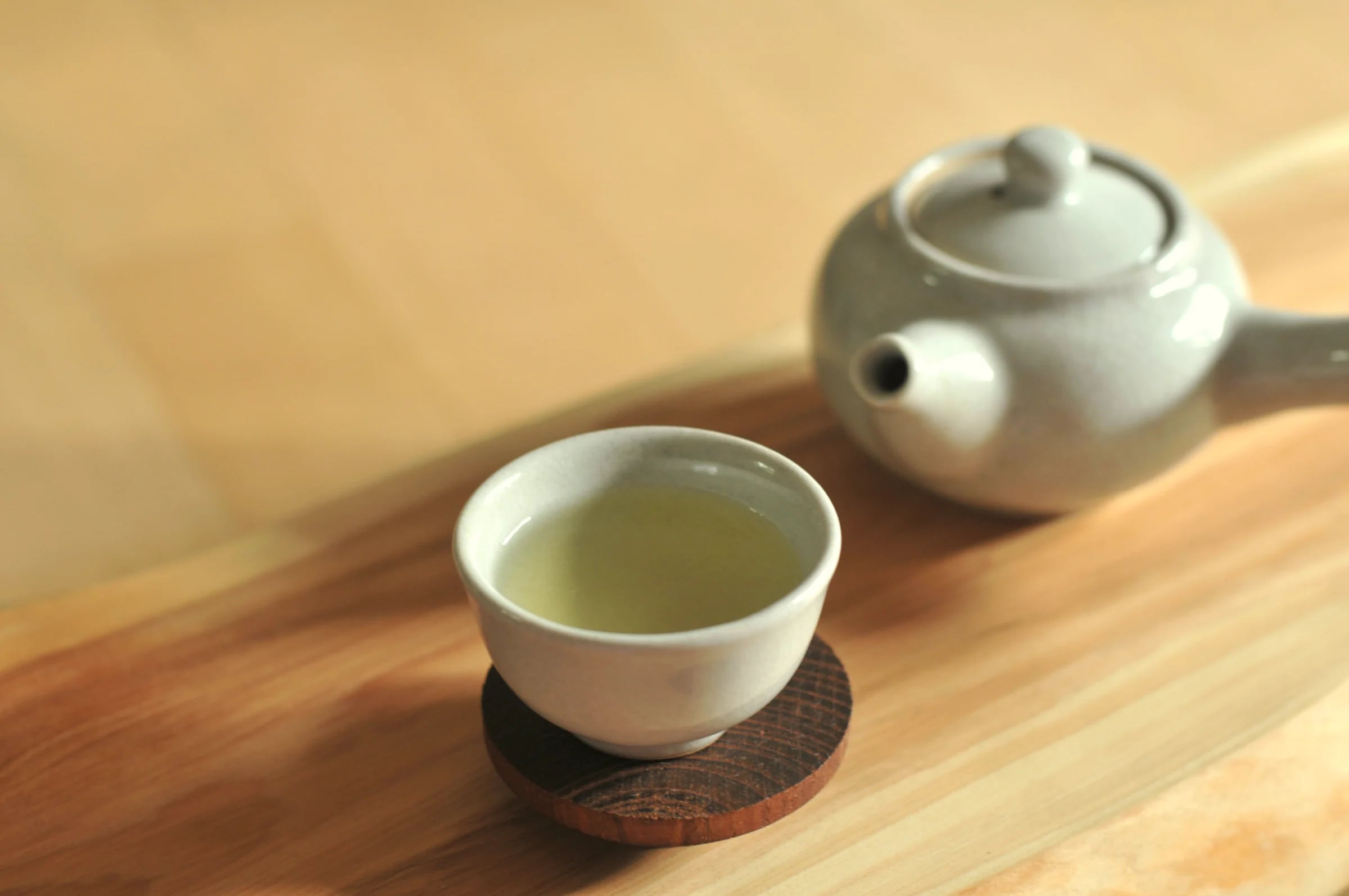
L-theanine is an amino acid found almost only in the tea plant, Camellia sinensis. Your body doesn't use it to build proteins, and you don't need it in your diet. It accounts for much of green tea's savoury, umami taste. It also looks chemically similar to glutamate, one of the brain's messenger chemicals, and that is why researchers started studying it.
Supplements contain far more than a cup of tea (the table further down compares them).
What does L-theanine do, and what are its benefits?
Its benefits are small and uncertain. When researchers pool the trials, theanine shows modest, short-term effects on reaction time and on how people rate their own stress and sleep. Most of the trials are small, many tested theanine mixed with other ingredients, and several were funded by companies that sell it.
Attention and reaction time
This is where the evidence agrees most. A 2026 meta-analysis of 31 randomised trials, involving 1,168 people, found that a single 200 mg dose taken 30 to 60 minutes before testing made people faster on a choice reaction-time task. A 2025 review from the University of Aberdeen's Rowett Institute found a small to moderate effect of the same kind in the first hour. Lipton Teas and Infusions part-funded that review, and one author of the 2026 analysis founded a supplement company.
Stress and anxiety
Here the evidence is weaker. In the 2026 analysis, the drop in short-term stress after one dose was modest and came largely from studies at high risk of bias, and the anxiety results were inconsistent. A 2020 systematic review of nine trials concluded that 200 to 400 mg a day might reduce stress and anxiety in people under stressful conditions, and asked for longer and larger trials.
The trial quoted most often, from Japan in 2019, gave 30 healthy adults 200 mg a day and a placebo, four weeks of each. Depression and anxiety scores improved while people took theanine, but the improvement wasn't significantly bigger than on placebo. The company that supplied the tablets funded the trial, and two of its employees were among the authors.
Sleep
A 2025 systematic review in Sleep Medicine Reviews took in 19 trials with 897 participants. Pooling the data showed small improvements in self-reported sleep: how long people took to fall asleep, how well they functioned the next day, and overall sleep-quality scores. The authors pointed out that few trials used theanine on its own, and that the right dose and length of use are still unknown. If sleep is your main worry, the NHS's first advice is a set of everyday habits, which our guide to magnesium and sleep sets out.
Can a UK supplement say L-theanine helps you relax?
No. The European Food Safety Authority assessed theanine claims in 2011, covering cognitive function, psychological stress, normal sleep and menstrual discomfort, and found that none had been substantiated. Great Britain's nutrition and health claims register lists every one of them as non-authorised. So a theanine product sold here may not claim to calm you, relax you, sharpen your focus or improve your sleep, whatever its marketing implies.
L-theanine and caffeine: what happens when you combine them?
This pairing is the most studied use of theanine, and caffeine seems to do most of the work. A 2014 meta-analysis of 11 placebo-controlled studies found moderate effects of caffeine plus theanine on alertness and on accuracy when switching attention, during the first two hours. The size of the effect tracked the caffeine dose more closely than the theanine dose. In a 2008 trial of 48 adults, 200 mg of theanine counteracted the rise in blood pressure from 250 mg of caffeine, but people felt just as jittery.
So theanine doesn't cancel caffeine out. If a focus capsule contains both, add its caffeine to your tea and coffee. The NHS says no more than 200 mg of caffeine a day in pregnancy, and our caffeine calculator adds up a normal day's drinks against the limits.
How much L-theanine is in green tea?
In a 2025 laboratory study, about 13 mg in a 200 ml cup. A 200 mg capsule is therefore roughly what you'd get from 15 cups. The researchers brewed 2 g of tea in 200 ml of water at 80°C for two minutes:
| Tea | L-theanine per 200 ml cup |
|---|---|
| Green | about 13 mg |
| Black | about 12 mg |
| Yellow | about 4 mg |
| Pu-erh | about 3 mg |
| White | about 2 mg |
| Oolong | about 2 mg |
| Supplement doses used in trials | 200 to 400 mg a day |
Brewing for longer raised both theanine and caffeine, though water temperature made no significant difference to theanine. A 2016 analysis of 37 shop-bought teas found that theanine varied widely within each type of tea, so take any single figure as a rough guide. Tea also brings caffeine: the NHS uses 75 mg for a cup of black or green tea.
L-theanine side effects: is it safe?
Trials report few side effects. The 2026 analysis of 31 trials found no serious adverse events, and the 2019 Japanese trial reported none over four weeks. Memorial Sloan Kettering Cancer Center's herb database says no side effects have been reported. Most trials lasted only days or weeks, though, so little is known about taking it for years, and the UK has set no upper limit for it.
Check with a pharmacist or GP first if:
- You're pregnant or breastfeeding. There's no safety data, and Memorial Sloan Kettering lists pregnancy and breastfeeding as reasons not to take it.
- You take sleeping tablets or sedatives such as diazepam, lorazepam or zolpidem, which Memorial Sloan Kettering flags as an interaction to discuss with your doctor.
- You take medicines for high blood pressure. Two small studies suggest theanine can blunt rises in blood pressure, and no study has tested it alongside these medicines.
L-theanine powder or capsules?
It's the same ingredient, and the difference is in measuring it. 200 mg is a fifth of a gram, too little to judge with a kitchen teaspoon, so use the scoop that comes with the powder or a scale that reads to 0.01 g. Capsules give you a fixed dose. Powder suits people who want to split a dose or stir it into a drink.
What's the best L-theanine supplement?
No single product is best for everyone. Check these on the label:
- How much L-theanine is in each serving. Most trials used 200 to 400 mg a day.
- Whether it's theanine on its own or a blend. Every extra ingredient has its own safety questions, and blend trials can't tell you what theanine did.
- Whether it contains caffeine. Many focus products pair theanine with caffeine, which counts towards your daily total.
- Whether it contains melatonin, a prescription-only medicine in the UK. A food supplement sold here shouldn't contain it.
- What it claims. A theanine product promising calm, relaxation, focus or better sleep is making a claim GB rules don't allow.
- Independent testing for purity and dose, which is worth looking for in any supplement.
If you take regular medicines, ask a pharmacist before you buy.
Can you take L-theanine and lemon balm together?
There's no evidence the combination does anything useful. The only trial we found that tested the two together also included valerian and saffron. It gave 64 adults with poor sleep the blend or a placebo for six weeks, and the blend did no better than placebo, whether sleep was measured with a wrist device or rated by the participants. No serious side effects were reported, and a Colombian food company paid for the trial. Lemon balm has no authorised health claims either; our lemon balm guide covers its research and safety.
Common questions
How long does L-theanine take to work?
Single-dose trials tested people 30 to 60 minutes after a 200 mg dose, which is when a 2026 analysis of 31 trials found slightly faster reaction times. Trials of daily use, such as a 2019 Japanese study, ran for four weeks or longer. The measured effects were small, and no product in Great Britain is allowed to claim that theanine calms or relaxes you.
Can you take L-theanine every day?
Trials have given it daily for up to eight weeks, one of them at 400 mg a day, without serious side effects. Nobody has studied use over years, and the UK has no official upper limit. If you take it daily, stick to the label dose, avoid doubling up through blends that also contain it, and ask a pharmacist first if you take sedatives or blood pressure medicines.
Is L-theanine safe in pregnancy?
Nobody knows, because it hasn't been studied in pregnancy or breastfeeding. Memorial Sloan Kettering Cancer Center's herb database lists both as reasons not to take it. Tea is a different matter: the NHS counts a cup of black or green tea as about 75 mg of caffeine towards the 200 mg daily limit in pregnancy. Ask your midwife or GP before taking any supplement.
Does green tea or black tea have more L-theanine?
They're similar. In a 2025 lab study, 2 g of green tea brewed for two minutes gave about 13 mg per 200 ml cup and black tea about 12 mg, while white, oolong and pu-erh gave much less. A 2016 study of 37 shop-bought teas found big differences between products of the same type, and longer brewing raises the amount.
Does L-theanine interact with any medicines?
No large studies have looked at this, so the cautions are precautionary. Memorial Sloan Kettering advises talking to your doctor if you take sleeping tablets or sedatives, as the effects might add together. Small trials suggest theanine can blunt rises in blood pressure, so ask a pharmacist first if you take blood pressure medicines. Also check any blend for caffeine.
Sources
- GOV.UK: Great Britain nutrition and health claims (NHC) register (L-theanine claims listed as non-authorised, EFSA Journal 2011;9(6):2238)
- Gerolymos et al. (2026), Cognitive and affective effects of L-theanine: a systematic review and meta-analysis of 31 randomized trials, Molecular Psychiatry
- Payne et al. (2025), Effects of tea or its bioactive compounds L-theanine or L-theanine plus caffeine on cognition, sleep and mood in healthy participants, Nutrition Reviews
- Bulman et al. (2025), The effects of L-theanine consumption on sleep outcomes: a systematic review and meta-analysis, Sleep Medicine Reviews
- Williams et al. (2020), The effects of green tea amino acid L-theanine consumption on the ability to manage stress and anxiety levels: a systematic review, Plant Foods for Human Nutrition
- Hidese et al. (2019), Effects of L-theanine administration on stress-related symptoms and cognitive functions in healthy adults: a randomized controlled trial, Nutrients
- Camfield et al. (2014), Acute effects of tea constituents L-theanine, caffeine and epigallocatechin gallate on cognitive function and mood: a systematic review and meta-analysis, Nutrition Reviews
- Rogers et al. (2008), Time for tea: mood, blood pressure and cognitive performance effects of caffeine and theanine administered alone and together, Psychopharmacology
- Yoto et al. (2012), Effects of L-theanine or caffeine intake on changes in blood pressure under physical and psychological stresses, Journal of Physiological Anthropology
- Ayakdaş and Ağagündüz (2025), Determination of L-theanine and caffeine contents in tea infusions with different fermentation degrees and brewing conditions, Foods
- Boros, Jedlinszki and Csupor (2016), Theanine and caffeine content of infusions prepared from commercial tea samples, Pharmacognosy Magazine
- Gutiérrez-Romero et al. (2024), Effect of a nutraceutical combination on sleep quality among people with impaired sleep: a randomised, placebo-controlled trial, Scientific Reports
- Memorial Sloan Kettering Cancer Center: About Herbs, L-theanine
- NHS: Foods to avoid in pregnancy (caffeine)
- NHS: About melatonin
This guide is general information, not medical advice. If you have a medical condition, take prescription medicines, or are pregnant or breastfeeding, speak to your GP or pharmacist before starting a supplement.
This product is a food supplement intended for use by adults aged 18 and over. It is not intended to diagnose, treat, cure, or prevent any disease. Consult a qualified healthcare professional before use, particularly if pregnant, breastfeeding, or taking medication. Individual results vary.
Further reading
Vitamins and minerals
Does magnesium help you sleep?
For most people, not by much. The trials are small and mixed, the clearest signal is in older adults and people who get little magnesium from food, and even there the effect is modest.
11 min read

Vitamins and minerals
Which supplements can you take together?
Most vitamins and minerals, vitamin C and zinc included, can be taken together. Keep iron about 2 hours away from calcium, tea, coffee and antacids, keep mineral supplements away from medicines such as levothyroxine, alendronic acid and some antibiotics, and add up your totals so two products don't take you past NHS limits.
15 min read
Sleep and mind
Glycine powder: what it does and where it's found
Glycine is the simplest amino acid. Your body makes it, and protein foods (gelatine above all) supply a few grams a day. The usual 3 g dose of glycine powder comes from three small sleep trials run by scientists at a Japanese amino acid company, and no health claim for glycine is authorised in Great Britain.
8 min read